
For recruitment agencies, business development is the real grind.
There’s always a pile of endless lead lists, duplicate data, no organization, and 8+ tools that you’re trying to make sense of.
All this gets recruitment agencies nowhere. Because they’re always buried under sheets, leaving little time to focus on winning new business.
Thus hustle is there, but the main reason for the reduced outcomes is wasted motion (case in point: using fragmented tools).
But the industry is shifting.
Agencies that focus on doing more with AI and using the “right” tool (not tools) leave the “notebook-and-sticky-note” crowd behind.
Plus, data backs this up: according to Bullhorn’s GRID 2025 report, recruiters can win back up to 17 hours each week with AI and automation.
That means every hour saved on admin is an hour gained in revenue.
This guide breaks down:
<!-- HTML -->
<div class="toc">
  <h2>Table of Contents</h2>
  <ul>
    <li>Clearing up what BD really means in recruiting</li>
    <li>Pinpointing the pain points holding agencies back</li>
    <li>Sharing the desk-level habits of top performers</li>
    <li>Showing how the right tech flips busywork into billings</li>
  </ul>
</div>

css
Copy code
/* CSS */
.toc {
  background-color: #f8f9fa;  /* light gray background */
  border-left: 4px solid #007bff; /* blue accent bar */
  padding: 20px 25px;
  margin: 20px 0;
  font-family: Arial, sans-serif;
  border-radius: 6px;
  max-width: 600px;
}

.toc h2 {
  font-size: 1.5rem;
  color: #333;
  margin-bottom: 15px;
  font-weight: bold;
}

.toc ul {
  list-style-type: disc;
  padding-left: 20px;
  margin: 0;
}

.toc li {
  margin-bottom: 10px;
  line-height: 1.6;
  color: #555;
  font-size: 1rem;
  transition: color 0.3s ease;
}

.toc li:hover {
  color: #007bff; /* hover effect to highlight */
  cursor: pointer;
}
And more.
Let’s start!
Business Development in Recruiting: More Than Just Cold Calls
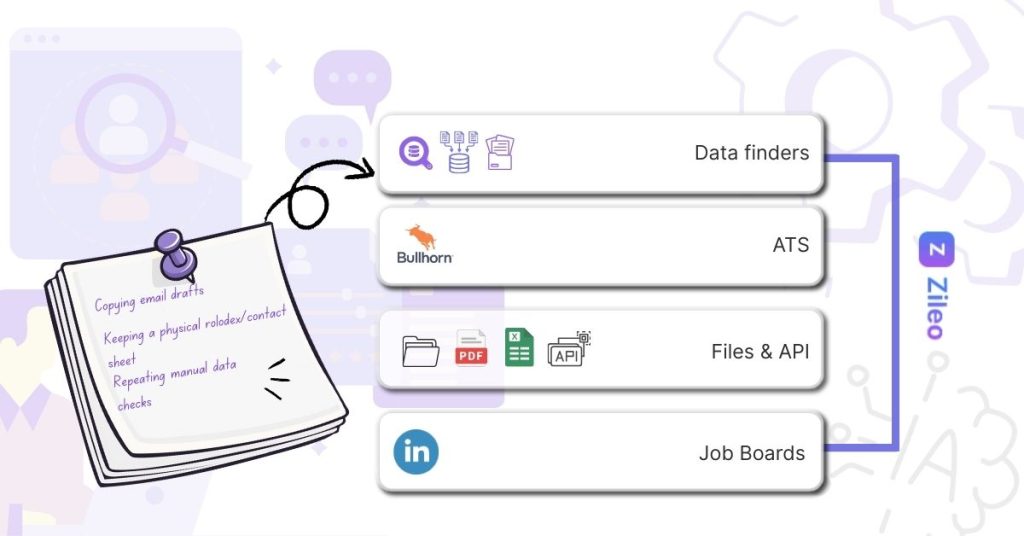
Before we begin, let’s get one thing clear: business development for recruiting is not the same as sourcing candidates.
Candidate sourcing = filling job orders with talent.
Client sourcing = creating a steady stream of companies that work with agencies to fill those roles.
Agencies that confuse the two end up with full candidate pipelines but no revenue pipeline.
Business development is what keeps the lights on and the desks filled.
Agencies vs Staffing Firms: Same Game, Different Rules
While we’re on the topic, let’s get another definition sorted:
Business development recruitment agencies don’t always run the same playbook as staffing agencies:
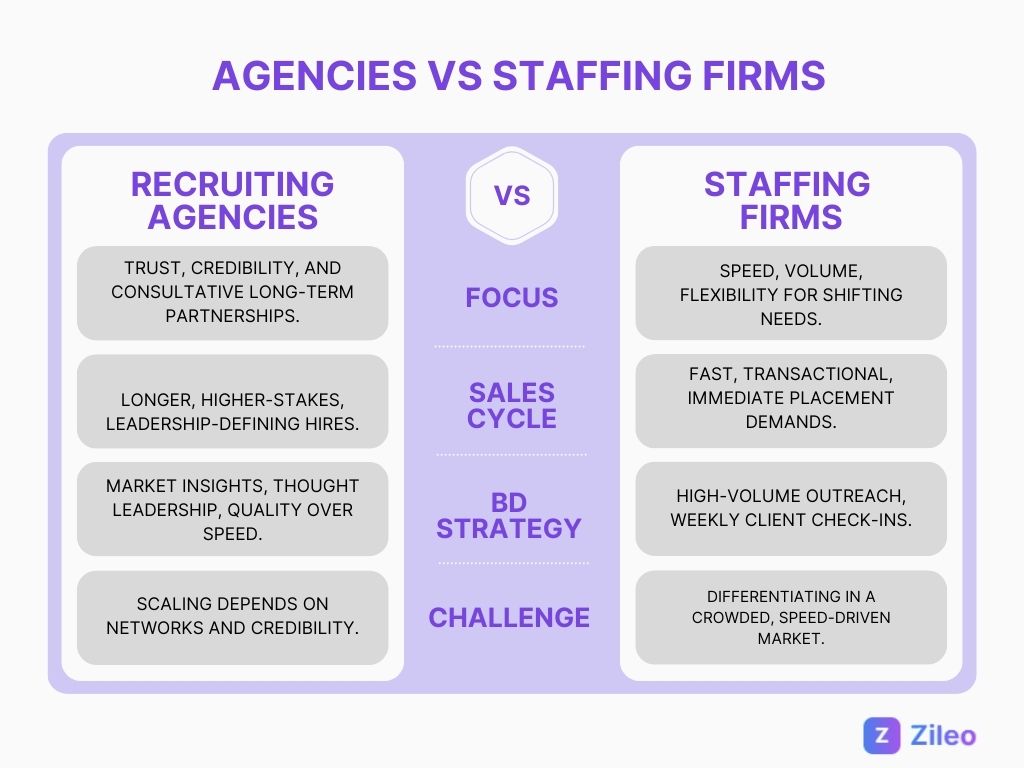
A comparison of agency and staffing firms.
Permanent recruitment agencies (contingency or retained) focus on long-term relationships. Their BD is about trust, credibility, and consultative selling.
Staffing business development is all about speed and repeatability. Contract and temp staffing agencies need consistent outreach that can scale, because the client’s needs change week to week.
Both models need strong business development in the recruitment industry, but the strategies differ.
What This Difference Means for Business Development
Here’s how the difference between recruitment agencies and staffing firms looks on the ground:
Messaging Must Match the Model
A retained search agency can’t win clients with the same pitch a temp staffing agency uses.
Talking about “speed” to a C-suite client looking for a CFO won’t resonate; they want strategic value.
Conversely, a temp staffing prospect doesn’t care about long reports or benchmarking studies.
They want to know things like: Can you get me 20 qualified temps by Monday?
Metrics for Success Differ
Recruitment agencies often measure BD success in terms of average fee size, exclusivity agreements, and client retention.
Staffing agencies measure success in fill ratios, speed-to-fill, weekly gross margin, and redeployment rates.
Technology Plays Different Roles
Recruitment agencies need tech that helps focus on research, relationship management, and personalization (we’re talking CRM insights, AI-generated outreach, email quality checkers).
Staffing firms need tech that supports scale, scheduling, and real-time matching (shift booking systems, bulk outreach, compliance checks).
Despite these differences, both models rely on the same foundation: consistent, structured business development (but we’ll be focusing on recruiting agencies in the article ahead, for now 🙂).
The Pain Points Every Firm Knows Too Well
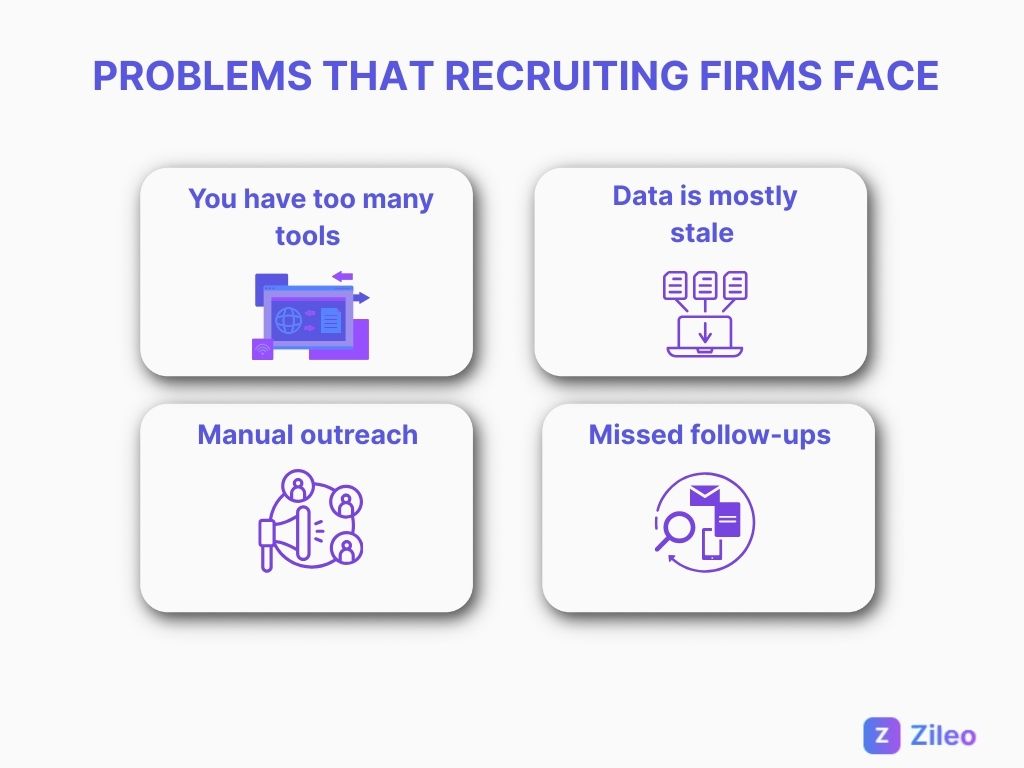
The problems recruiting firms face in business development.
If you’re in the trenches, these will sound familiar:
You have too many tools
Job boards, LinkedIn automation, CRMs, email platforms… none of them talk to each other. Every recruiter is forced into playing “software glue,” wasting hours moving data around instead of moving deals forward.
Stale data
Bouncing emails, outdated phone numbers, contacts who left months ago.
Every bad record means wasted dials, empty inboxes, and a pipeline that looks full but converts at a fraction of what it should.
Manual outreach
Copying, pasting, logging, chasing. Every message sent feels like progress, but in reality it’s admin work disguised as sales. The more manual steps, the fewer actual conversations.
Missed follow-ups
Because no one (not even the best recruiter) can track 200+ conversations in their head or on sticky notes. Each missed follow-up isn’t just a lost email; it’s a competitor gaining ground while you look unresponsive.
And these problems compound. One bad email list becomes a wasted calling block. One missed follow-up snowballs into a lost client.
Multiply that across the team, and suddenly the firm’s BD engine isn’t broken because of a lack of talent; it’s broken because of inefficient systems.
What Makes Business Development Work (At the Desk Level)
At the end of the day, business development doesn’t happen at the “agency” level; it happens at the consultant’s desk.
The difference between a recruiter who just dials numbers and one who consistently brings in new accounts comes down to habits and systems.
Here are five things that the best-performing folks do:
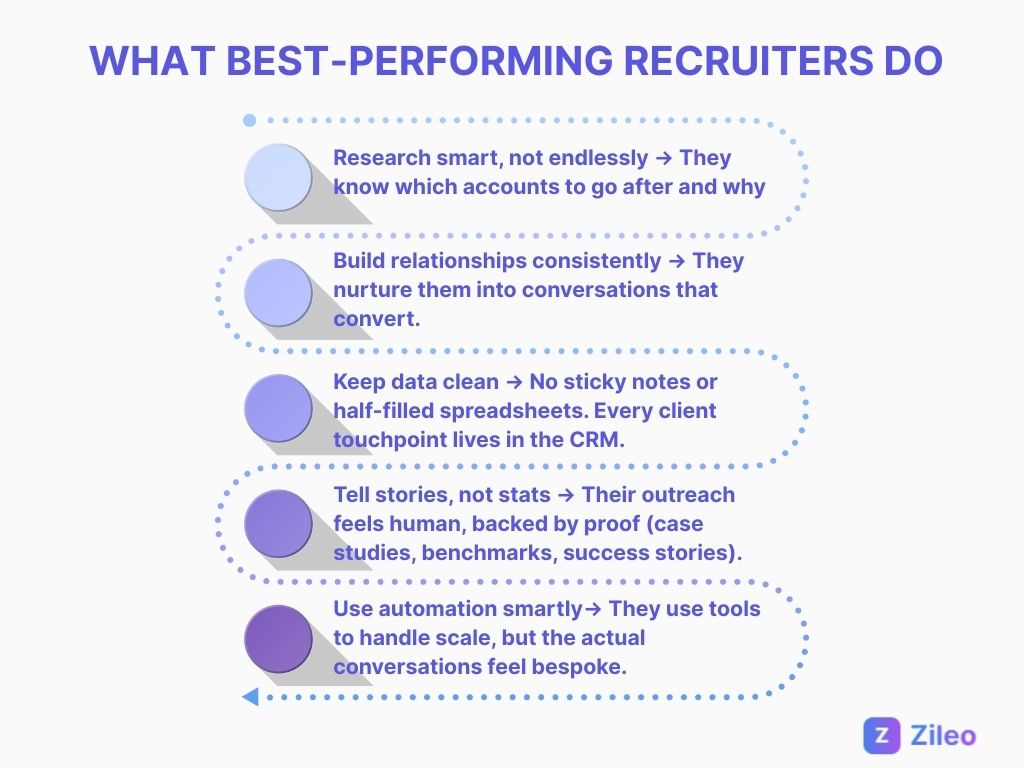
When consultants get these basics right, agency BD becomes predictable instead of “hit or miss.”
How Tech Flips the Script for Recruitment
The days of 100% manual business development were already over; we’re moving to the next step now.
As of 2025, there are 100s of outbound tools out there (there’s no exact figure). But, there’s no “complete” tool that solves 100% of your business development problems.
The agencies that do use recruitment tools have them all scattered:
Automated Job Sync: pull in postings from job boards, filter duplicates, and send to your CRM.
Contact Enrichment: find verified emails, phone numbers, and LinkedIn profiles instantly.
Outreach Sequences: automated email + LinkedIn campaigns that pause when someone replies.
CRM & Task Management: a place to track deals, tasks, and relationships.
And these are just the basics.
As a recruiter, you don’t need more work on your plate. You need efficiency. And you need business. And you need it without putting in a lot of work.
That’s precisely why Zileo exists :).
It’s an everything-included-no-effort-needed tool that takes a recruiter from job posting → enriched hiring manager contact → automated LinkedIn connect + personalized email, all in minutes, without switching tools.
And that’s what we call turning busywork into billings :).
In other words: tech + process = growth.
That’s how you build a pipeline that doesn’t just feed today, but scales tomorrow.
Ready to see it in action? Try Zileo today and get 50 free leads 🙂
About Zileo: The All-in-One Business Development Platform
Zileo is the all-in-one business development platform for recruitment agencies and B2B sales teams. From job sync to contact enrichment and automated outreach, it is a complete platform that saves time, keeps you organized, and helps grow your business.
FAQs
What does business development mean in recruitment agencies?
Business development in recruitment agencies means finding and building relationships with new clients, not just sourcing candidates. It’s about creating a steady pipeline of companies that trust your agency to handle their hiring needs.
Why do recruitment agencies struggle with business development?
Most struggle because of disconnected tools, stale data, manual outreach, and missed follow-ups. These inefficiencies drain time and make it hard for consultants to focus on winning new business.
How can recruitment agencies scale business development?
By using one system that combines job syncing, contact enrichment, outreach automation, and CRM tracking. This eliminates wasted motion and frees recruiters to focus on building trust with decision-makers.
What’s the difference between business development in recruitment agencies vs. staffing firms?
Recruitment agencies focus on long-term, relationship-driven sales cycles (e.g., executive search). Staffing firms focus on high-volume, fast-moving placements. Both rely on consistent business development, but the strategies and tools differ.
How does Zileo help recruitment agencies with business development?
Zileo replaces 6–8 scattered tools with one platform. It pulls in jobs, enriches contacts, automates outreach, and tracks deals, helping agencies scale business development without wasting time on admin.